Thursday, June 01, 2023

Caminito #1: Bloomfield to Newark/Harrison along the Lenape Trail

 A lovely May Thursday. I'd be mad not to use it! So I get the backpack on and take off! Finally doing the Lenape Trail!


Clark's Pond, Bloomfield.


Yanticaw Park/Booth Park, Nutley.


Belleville Park, Belleville


Path washed away by recent storms, just above Branch Brook Park Drive, Newark


Footbridge over Branch Brook Park Drive, Newark.


Of course it's safe!


Branch Brook Park, Newark.


Cathedral Basilica of the Sacred Heart, Newark.


Branch Brook Lake, Newark.


Essex County Hall of Records, Newark. Hmm . . . what are those big letters on the street?


St. James African Methodist Church, Newark.


Streets of Newark.


Campus Town, Newark.


War Memorial, Military Park, Newark.


Newark Downtown over the Passaic River.


Southward view along restored riverfront walk, Newark.


They didn't knock the Ballantine House down!


Old Presbyterian church now converted to an "Innovation Cathedral" by Audible. Next door Rutgers Business school and dorm building.


The first third of my Lenape Trail caminito finished. What a wonderful walk! Newark really surprised me at the end, and I must return there for more exploring!


Labels: , , , , , , ,

Monday, July 27, 2020

Blown Capacitor on Samsung SV-5000W VCR

Blown capacitors are a common problem with VCRs. In this case I simply overloaded the unit, using it not just as a video player but also as a PAL to NTSC converter, since it had both input and output ports.


Symptom: unit not powering on; power light flashing red
Remove covers, being sure to label all screws. BE GENTLE when doing this - the plastic is brittle.

Scan the printed circuit board for faulty capacitors. Can you see the blown one in the picture below?


Look closer!
It's the one with the convex top. See how the other capacitors have flat tops? This one swelled and then blew right where the three lines meet - hence the holes at that point. This capacitor is now dead, and must be replaced. Fortunately our picture also tells us that it's a 1000μF unit with a maximum rated voltage of 16v. The capacitance is the most important figure.


Unless there's an electronics store nearby, you'll need to send away for the capacitor. They're easily available on eBay.

Removing this capacitor (and you WILL have to remove it) is the greatest difficulty. The only way to get at the underside of this PCB is to disassemble the entire VCR or to cut a hole through the plastic floor of the VCR. Disassembling the VCR completely is impossible, as there are too many parts, and it would take *ages*. Instead, measure the distance from the edges of the PCB to the capacitor, turn it upside down, and carefully cut a large hole over the spot where the capacitor is. Your measurements should tell you which stubs are those of the blown capacitor. Now the capacitor will be exposed both above and below.


Get your soldering iron. If you have a solder removal kit, so much the better. Firmly gripping and pulling the capacitor with one hand, use the other hand to heat the relevant stubs on the rear side of the PCB with the soldering iron. It will eventually pull free. Two holes will be left in the PCB.

Now, being sure to remember the polarity of the capacitor (do NOT install the new one backwards!), thread the new capacitor through the holes in the PCB and bend them so that the capacitor doesn't fall back through again. Turn the player upside down so that the stubby side is facing up.

That's the old capacitor at the top of the image. I just put it in for comparison. But the important thing here is the hole which I cut in the plastic case to get at the bottom of the capacitor, and the legs of the capacitor, which you can see threaded through the holes and bent away from each other.

Bend them away from each other, right at the surface of the PCB. Now VERY CAREFULLY melt a drop of solder onto each point of contact. When you're satisfied (test this process on a dead PCB first of all) very gingerly snip the feet of the capacitor so that they are no longer protruding.

Plug the unit in and test it. If it's functioning, you're done! Congratulations! If not, go through the process again; there may be another capacitor blown.

Reassemble the unit. Hopefully you remembered to label the screws!

Enjoy your old video tapes!

Labels: , , , , , , , , , , ,

Wednesday, December 07, 2016

Rutgers Phonology Project

Helping out a Rutgers doctoral student with her project on Irish phonology.


Labels: , , , , , ,

Tob-Ghaeltacht / Pop-Up Gaeltacht NYC Nua Eabhrac

Róstálamar an gabhar go smior aréir i Murphys ar Aibhinne #2! Maith sibh Siobhán agus Fran as é a eagrú!

Pop-Up Gaeltacht in New York City!


Labels: , , , , , , , ,

Friday, May 20, 2016

Fixing a Leaking GE Washing Machine

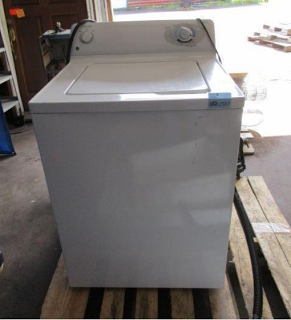
We have a pretty standard GE Washing Machine. Looks just like this one (which is just a screen grab off the Internet, and not actually our machine!):
https://blogger.googleusercontent.com/img/b/R29vZ2xl/AVvXsEjLdbOwu2cdtsl-lvNCgHKrWBe2e6RuJXpR_bmrKrrt-82EIB7s0adDqsZbFYkS0JrFkR4Cgqn_DiNFu2acObuDWeuVJdXvhSm0KX3I_bwl9-xuEJ5Jz3wT5en7o5srEyygin9y/s320/Our+Washing+Machine.png

Our model is a WHDSR109J8WW, but honestly they're all very alike.
This washing machine had recently started leaking, and I thought it might be the end for it. But in the spirit of experimentation, I figured I'd try fixing it.
To my knowledge, these machines are well built, and unlikely to corrode. If there were to be a leak, it would likely be in the water inlets (the two hoses on the back attached to your house water supply) or in the water pump/drain system (the larger pipe at the back that attaches to your slop sink or waste-water system). Aside from the pump, these pieces are *very* repairable, and usually require parts that can be bought for several dollars at your local hardware or plumbing supply store.
If the leak is coming from the drum, there's really no point repairing the washing machine. It's just too much work, and the parts are probably quite expensive.

Moving the machine.
Plug the machine out. I'm not kidding. This thing has 240V of electricity, which is double your usual household supply. If you touch the wrong wire you will get a very unpleasant jolt.
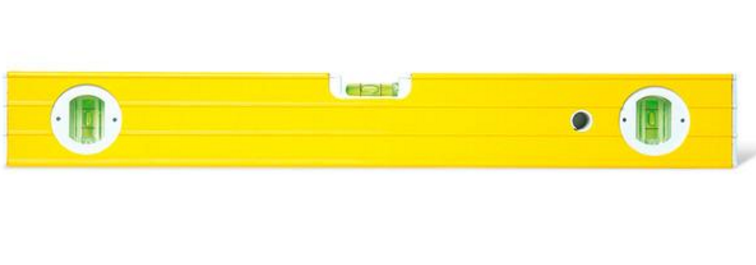
Hopefully your machine has extendable plastic hoses, because you're going to need to pull it out from the wall and stand it somewhere where it can still run while you have access to the back of it. You'll need no more than a foot or two of extra space. Pull it out *carefully*. You might need help. Make sure it's standing upright, and use a level, if possible:
The first thing to do is remove the front panel. You'll need something like a putty knife, which you're going to *carefully* slide between the top of the washing machine and the front panel.
Be forceful, but not aggressive, and don't scratch the panel. It will (or should) pop out.
Now have a look around. See can you find the source of the leak. Don't detach anything, don't yank anything - just look around.
In my case, NOTHING SEEMED TO BE LEAKING. The pipes and hoses were clean and dry; the drum looked sound, and the pump was dry.
This was a conundrum. What was causing the leak?
In the absence of an easy solution, I turned to the internet and did several hours research.
In the end, one silly solution presented itself:
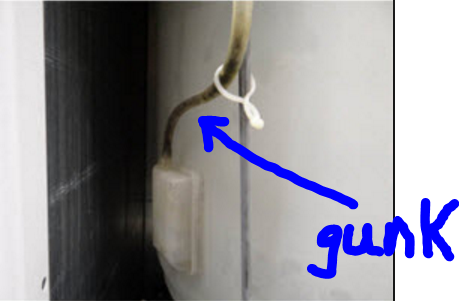
The washing machine detects the amount of water in the drum using a pressure gauge. You'll see a small box-like chamber attached to the drum, from which a very narrow hose runs. If you were to follow the hose, you'd find it goes up to the load-size selector switch on the control panel. This hose can fill with lint, and when this happens the pressure gauge fails. When the pressure gauge fails, the machine doesn't know when to stop filling the drum with water, and the machine overflows.
All you need to do is clean out this hose.
Remove the top panel. There are screws on the back. After you've removed these, slide the panel to one side and lift it out. You'll see the other end of the hose attached to the load-size selector on the left. The hose is easily worked off the selector and the pressure box on the drum. Remembering exactly how it ran, remove it and use whatever you have at hand to clean the lint and gunk out of it. Once you're satisfied that the hose is completely clean, run it back through the various conduits it was in and reattach it at both ends.
Note: if this little hose is NOT blocked or gunked up, then the leak is probably coming from somewhere else. I can't help you if that's the case.
Now reassemble everything, plug the machine back in, and try it out. Select a rinse, being sure to select the largest load possible.
If everything works as planned, your leak will have disappeared.
Put the washing machine back into its place. You're done.


Labels: , , , , , , , ,

Wednesday, March 23, 2016

Chaperoning a School Group to Liberty Science Center

Manhattan Skyline from Liberty Science Center

Fiona Agog at the Animals

Erm . . . a Lizard?

Definitely a Snake

Yup - a Tarantula!

Taking Off! (Exhibit on Infectious Diseases)

Bee Hive - No Bees

The Bee Crowd

Fish Tank

Yes - that is a dinosaur

Rat in Maze

How Can a Creature so Cute Not Have a Name?


Statue of Liberty through the Trees

Freedom Tower (Financial Center)

Labels: , , , , ,

Tuesday, October 27, 2015

Nuacht as Meiriceá

Friday, November 21, 2014

Amharc as Nua Eabhrac - "GAA-USA"


Beidh clár 5 de "Amharc as Nua Eabhrac" á chur amach ar Raidió na Life anocht (Dé hAoine, 21ú Samhain) ag 730pm am na hÉireann (230pm am Nua Eabhrac). 

Sa chlár seo labhraíonn Brian Ó Broin le Seán Ó Cualáin (Sónta Teo.) agus Dara Ó Cinnéide (Raidió na Gaeltachta, agus iar-Chaptaen Peile Chontae Chiarraí) faoina gclár nua teilifíse "GAA-USA" agus an fáth go bhfuil siad ag taifeadadh i gCathair Nua Eabhrac.

Má chailleann tú an craoladh, is féidir éisteacht arís tríd an gclár a íoslódáil ón suíomh seo (buíochas le William Paterson University as an gcead an clár a choinneáil ar an bhfreastalaí seo).

Is féidir éisteacht leis an gclár ar iTunes freisin. Téigh go dtí an iStore agus cuardaigh "amharc".

Labels: , , , , , , ,

Tuesday, September 02, 2014

Amharc as Nua Eabhrac Eagrán 4

Ag cur críoch leis an gcéad eagrán eile de "Amharc as Nua Eabhrac", an podchraoladh as Nua Eabhrac.
Nearly finished editing the next episode of "Amharc as Nua Eabhrac", the New York Podcast!

Labels: , , , , ,

Friday, August 29, 2014

Kayaking from Kearny to Downtown Newark

Started out at the boat launch in Riverbank Park, Kearny. Paddled to the Amtrak Bridge in downtown Newark and back.
Frank A Vincent Boat Launch (1970!)

Local Wildlife displeased with the new arrival


Industry on the Belleville side

Industry on the Belleville Side


Abandoned Railway Bridge, Passaic River, Newark

Newark

Swing Bridge, Newark

Drawbridge, Newark


Heading back North Again, Passaic River, Newark


I sure was


Nearly back!

Massive Counterweight on drawbridge


Labels: , , , , , , , ,